Twenty Minutes That Save Ten Hours: Checking a Topic Before You Film
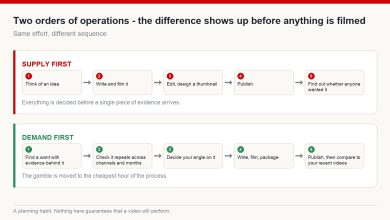
The most expensive mistake in this job is not a bad edit. It is ten hours of good work spent on a subject nobody was going to watch.
I made it repeatedly in my first years. An idea would arrive, it would feel obviously good, and the excitement carried straight through filming, editing and thumbnail design. Then it would publish to almost nothing, and the only honest explanation was that I had never once checked whether the subject had an audience before committing a week to it.
Now every video passes a check first. It takes about twenty minutes. It does not tell me a video will succeed – nothing does – but it reliably catches the ideas that were never going to work, which turns out to be most of what a check is for.
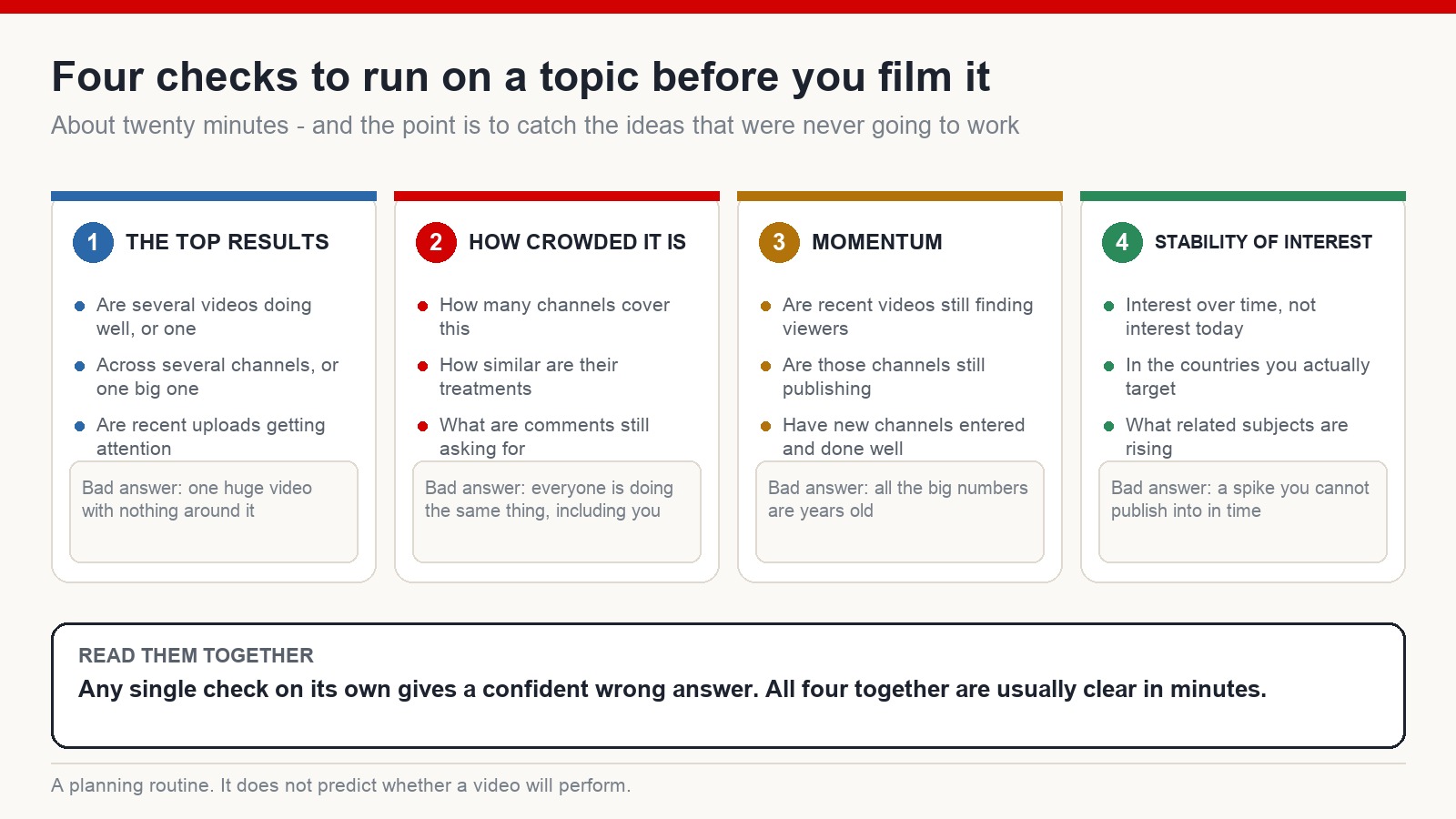
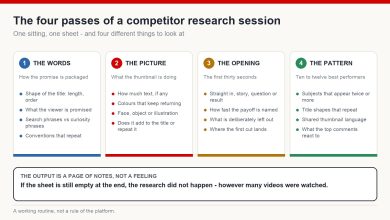
Check one: how the whole top of the results is doing, not one video
Search the subject the way a viewer would phrase it, and then look at the first screen of results as a group.
The questions are simple. Are several videos doing well, or exactly one? Is the strong performance spread across different channels, or concentrated in a single big one? And are recently published videos getting traction, or is all the attention sitting on things uploaded years ago?
Several videos from several channels performing decently is the signal you want. It means the interest belongs to the subject rather than to one creator or one lucky moment. One enormous video surrounded by nothing usually means you are looking at an event, not a market.
Check two: crowding, and the better question underneath it
Most people ask whether there is competition. That is the wrong question, because the answer is almost always yes, and it decides nothing.
The useful question is whether there is room for a version that is different in a way viewers would notice. So look at what already exists and ask: how many channels are covering this, how similar are their treatments to each other, and what are people still asking for in the comments that nobody has answered?
A crowded subject is usually evidence that demand is real – that is why everyone is there. What kills you is not the number of competitors but sameness: entering a subject where everyone is doing the same thing and doing the same thing yourself. If every existing video is a list and the comments are full of people asking how something actually works, that gap is the opportunity.
Check three: momentum
Total views are a record of the past. What you want to know is the direction of travel.
Look at whether recent uploads on the subject are still finding an audience, whether channels covering it are publishing consistently rather than having drifted away, and whether new channels have entered the space recently and done well. That last one is the most encouraging sign there is: it means the subject is still open to newcomers rather than locked up by incumbents.
The pattern to be wary of is a subject where all the big numbers are two or three years old and everything published this year is quiet. Sometimes that means the audience has moved on. Sometimes it means the subject has been answered so thoroughly that there is nothing left to add. Either way, it is a warning worth taking seriously.
Check four: is the interest stable or a spike?
A subject can look enormous today and be gone in three weeks. Before you invest, look at interest over time rather than interest right now, and look at it for the countries you are actually targeting – demand for a subject can be strong in one English-speaking market and negligible in another.
Also glance at what is rising around it. Related subjects that are heating up will often tell you where the audience is heading next, which is more useful than knowing where they are today.
Spikes are not forbidden. They are just a different kind of bet: fast to make, fast to decay, and worth taking only if you can publish while the interest is still there. If you want a library that keeps working, most of what you make should have stable interest behind it.
No single check decides anything
This is the part people get wrong. Each check on its own produces a misleading answer.
A subject with obvious demand and heavy crowding is not automatically bad – it just means you need a real angle. A subject with almost no competition is not automatically an opening – it is often empty because nobody wants it. Strong historical views with no recent traction is a trap. Rising interest with no existing videos might be genuinely early, or might be a subject that does not convert into watch time.
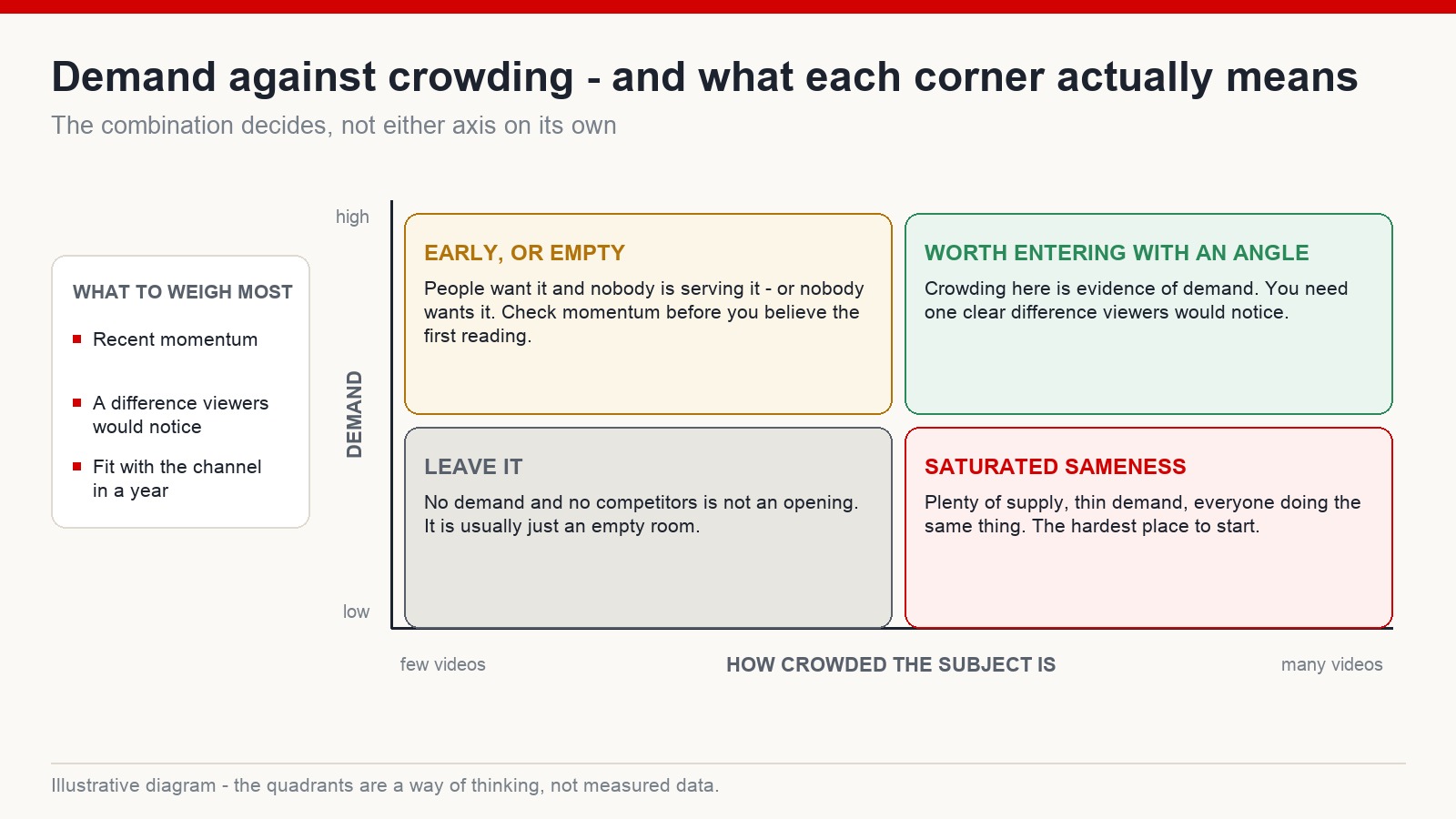
Read the four checks together and the picture is usually clear within a few minutes. Read any one of them alone and you will confidently make the wrong call.
The checklist I actually run
Before committing production time to a subject, five things need to be true, or close to it:
Several videos on this subject are doing well, across more than one channel. Recent uploads are still getting attention, not just old ones. I can name the specific way my version will be different. Interest in the subject looks steady rather than momentary. And it fits where I want this channel to be in a year.
Mostly yes means go. Two or more clear noes means the idea goes back in the file – not deleted, just not now. Subjects come back around, and an idea that fails the check today sometimes passes it six months later.
What the check cannot do
It is worth being straight about the limits, because a checklist can create false confidence.
None of this tells you whether your video will be good, whether your packaging will earn the click, or whether the recommendation system will show it to anyone in the first place. Plenty of well-chosen subjects go nowhere because the execution missed, and results vary enormously between channels, formats and audiences.
What the check does is narrow the range of outcomes. It removes the ideas that were doomed at the concept stage, which is a large share of them, and it means that when a video underperforms you can look at the execution instead of wondering whether the topic was ever viable.
Twenty minutes against ten hours
You do not need the perfect subject. Perfect subjects mostly do not exist, and waiting for one is its own way of never publishing.
You need a subject with enough signals behind it to justify the time you are about to spend. Twenty minutes of looking is a cheap price for not spending a week on something the audience had already decided it did not want – and unlike editing skill, this is a habit you can adopt in full, today, on your very next idea.
Frequently asked questions
Should I avoid subjects that already have a lot of videos?
Usually not. Competition tends to be evidence that demand exists. The thing to avoid is entering a crowded subject with a version indistinguishable from what is already there.
Should I only make videos about what is trending?
No. Trend-driven videos can bring a burst of attention, but they decay quickly. A library built mostly on subjects with steady interest keeps working long after any individual trend has passed.
How long should this check take?
Twenty to thirty minutes per subject once you are used to it. If it is taking hours, you are researching a whole niche rather than checking a single video idea.
How often should I re-check a subject I already cover?
Whenever performance shifts noticeably, or every few months as a matter of routine. Audiences move, and a subject that worked reliably last year can quietly stop working.
What if the checks disagree with each other?
That is normal, and it is why you read all four together. Weigh recent momentum most heavily, then whether you have a genuinely different angle – those two carry more information than raw view counts do.
If you want the fuller process this check belongs to – choosing subjects, packaging them and producing for an English-speaking audience – that is what I teach at mmoyoutube.com.